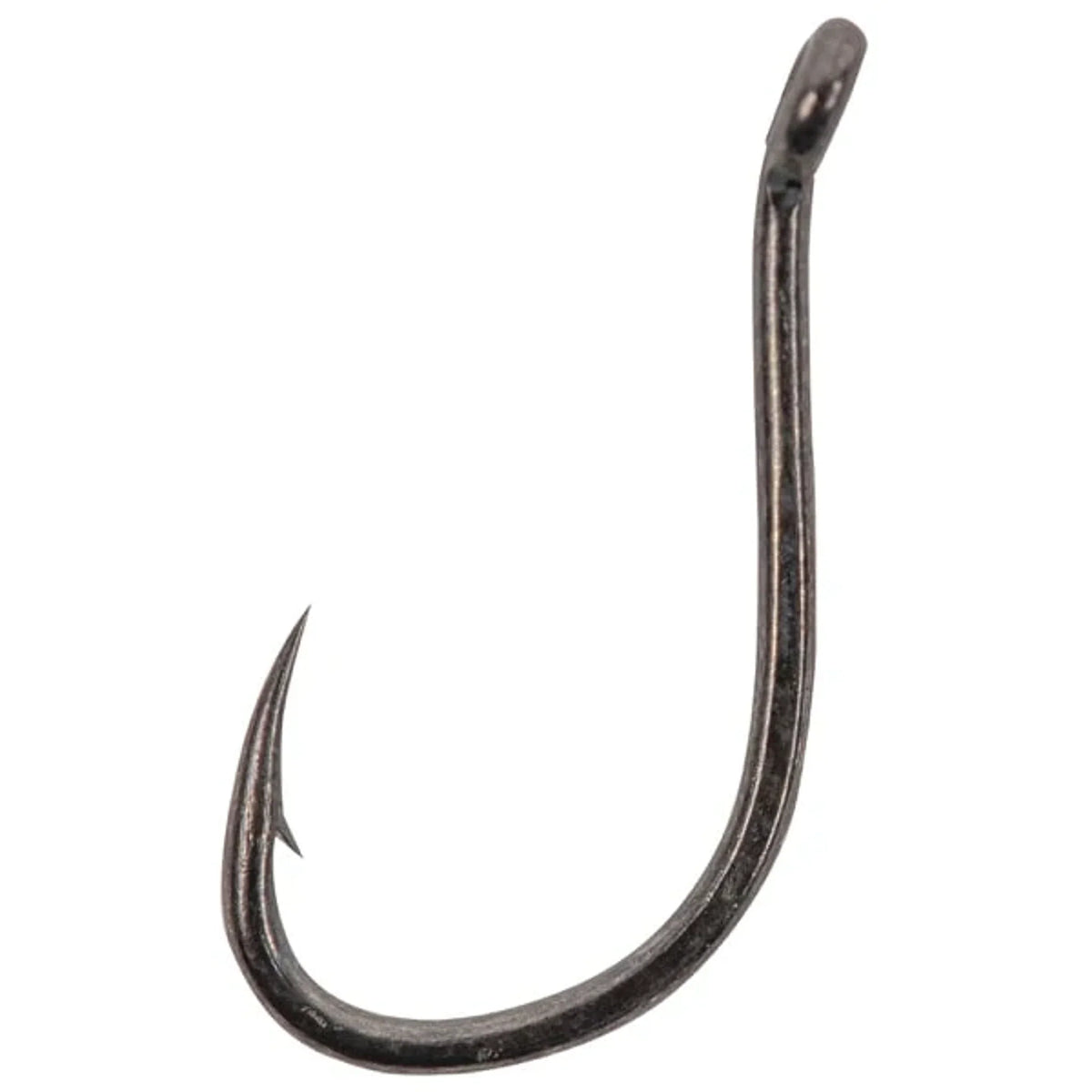
A feeder hook may seem like a small part of your rig, but it directly affects bait presentation, hook holds and control during the fight. A hook that works perfectly with two maggots may be far too light or too small for a pellet on a hair. A strong carp hook, on the other hand, may be unnecessarily heavy when fishing for cautious roach or bream.
The right choice therefore starts not with the brand, but with four questions: what bait are you using, are you presenting it directly on the hook or on a hair, what fish do you expect and what are the rules of the fishery? In this guide, you will learn how to match size, shape, wire thickness and attachment.
Want to compare the available models right away? View the full collection of hooks for coarse and feeder fishing. Want to choose your feeding system first? Also read our guide to method feeders, mesh feeders and open-end feeders.
Quick choice: which feeder hook suits your bait?
The sizes below are practical starting points. In standard hook sizing, a lower number means a larger hook, but hook patterns from different manufacturers may vary slightly at the same size. Always check that the hook remains in proportion to the bait and adjust it if you miss bites or lose fish.
| Bait and presentation | Logical hook type | Practical starting size | Why? |
|---|---|---|---|
| One or a few maggots or casters on the hook | Fine or medium-strong spade-end hook | 16–20 | Compact, natural presentation |
| Worm, corn or meat directly on the hook | Medium-strong to strong spade-end or eyed hook | 12–16 | Enough room for larger bait |
| Soft 4–6 mm pellet on the hook | All-round spade-end hook | 14–18 | The hook stays in proportion to the bait |
| 6–8 mm pellet on a bait band or hair | Eyed hook with sufficient hook gape | 12–16 | Easier to tie with a hair or band |
| Wafter or small boilie on a hair | Stronger eyed hook | 10–14 | Suitable for a knotless knot and larger fish |
| Large carp or fishing near obstacles | Extra-strong model, matched to the bait | Often 10–14 | More reserve during a hard fight |
Do not use this table as a fixed rule. A small but strong hook can be better for big fish than a conspicuously large model. Conversely, a large piece of bait needs enough room in the hook gape to keep the point clear.
Start with the presentation: bait on the hook or on a hair?
The most important choice comes before hook size. First decide where the bait will go.
Bait directly on the hook
Maggots, casters, worms, corn, meat, paste and soft pellets are often placed directly on the hook. Both spade-end and eyed hooks can be suitable for this, but a spade-end pattern usually provides a particularly compact transition between line and hook.
For a subtle presentation for roach or bream, choose a relatively light hook that does not unnecessarily weigh down the bait. If you expect carp, tench or large bream, choose a stronger pattern without automatically going several sizes larger.
A feeder-focused example is the Guru LWGF Micro Barb Spade End Feeder Special. This strong spade-end hook is available in several sizes and is suitable for pellets, corn, meat and paste, among other baits. Only use a microbarb pattern where fishery rules allow it.
Bait on a hair, bait band, bayonet or spike
Hard pellets, wafters and small boilies are often presented beside the hook when method and feeder fishing. The bait is then attached to a hair, bait band, bayonet or spike. The hook point remains completely clear, allowing the rig to hook quickly.
For this presentation, an eyed hook is the simplest choice. You can tie a knotless knot with it and precisely match the hair length to the bait. The hair should not be so short that the bait blocks the hook gape, but it must be long enough to allow the bait to move freely away from the hook bend and let the hook turn properly.
The Guru Super MWG Barbless Eyed is a strong barbless pattern with a generously sized hook eye. It is suitable for various baits, including pellets, maggots, corn, meat and small boilies. Those looking to use a ready-tied hair rig with bait band can also choose the Preston KKM-B Banded Hair Rigs. The short 10 cm version is designed for method and pellet feeder fishing; the longer 38 cm version is better suited to a classic feeder or pellet waggler.
Eyed hook or spade-end hook: what is the difference?
With an eyed hook, the line passes through or alongside the metal eye. This makes this type practical for a knotless knot, hair rig and bait band. An eyed hook is also easy to retie when you want to quickly change size or pattern at the waterside.
A spade-end hook has a flat end at the top. The line is secured along the hook shank with a special spade-end knot. This creates a neat, compact rig and is popular for maggots, casters, worms, corn and soft pellets fished directly on the hook.
Neither system is always better. Use this simple rule:
- bait directly on the hook: a spade-end hook is often the most subtle choice;
- pellet, wafter or boilie on a hair: an eyed hook makes the setup easier;
- quick and easy fishing: choose a ready-tied hooklength with the hook size, line diameter and length already matched.
Do you find tying a spade-end hook difficult? The Preston GPM-B Spade End Hooklengths Barbless 15 cm are ready tied and combine a Barbless GPM-B hook with Reflo Power line. This means you only need to choose the right size and line diameter.
Barbless, microbarb or barbed?
Always check the fishery rules first. Many commercial fisheries allow only barbless hooks, while other waters may permit a microbarb or a standard barb.
Barbless
A Barbless hook is easy to remove and is often compulsory on commercial fisheries. During the fight, consistent line tension is important. Do not allow the line to go slack, and use a rod action and drag that absorb shocks well.
Microbarb
A microbarb is a very small barb. It can be useful where rules allow it and you want extra holding power, for example when using natural bait. Still handle the fish calmly and remove the hook using suitable unhooking equipment.
The Guru LWGF XS Micro Barb Eyed is an extra-strong eyed pattern with a wide gape and a beaked point. It is designed for demanding situations and can be used with a hair or bait band for pellets, wafters, sweetcorn, meat and worms, among other baits.
Barbed
Use a barbed hook only where it is permitted on the fishery. Do not automatically choose the largest barb: hook pattern, sharpness, a properly adjusted drag and constant pressure during the fight are at least as important.
What hook size should you choose for pellets?
The pellet diameter is a useful starting point, but hardness, attachment and target fish also matter.
- 4 mm pellet directly on the hook: often start around size 16–18;
- 6 mm pellet on the hook or in a bait band: often start around size 14–16;
- 8 mm pellet on a hair or band: often start around size 12–14;
- larger pellet or mini boilie: start around size 10–12 and check that the hook gape remains clear.
A smaller hook does not automatically result in more bites. If the bait blocks the hook point or gape, hook-ups are actually worse. After attaching the bait, check that the point is completely clear and that the hook can turn naturally next to the bait.
Do you use soft pellets directly on the hook? The Captura Baits Soft Hook Pellets are available in 4, 6 and 8 mm. For feeder or method fishing, you can let them harden slightly according to the product instructions so they stay on the hook better during casting.
Which hook size should you choose for maggots, worms and sweetcorn?
For one or two maggots or a few casters, size 16–20 is usually a sensible starting point. The hook must be light enough for a natural presentation, but strong enough for the expected fish. When there are many small fish, you can start fine; if bream, tench or carp regularly show up, a stronger hook pattern is wiser.
For a worm, a grain of sweetcorn or a piece of meat, size 12–16 is often suitable. Hook the bait so that the hook point and part of the gape remain clear. A wider gape may be needed for a whole worm or several grains of sweetcorn.
Also consider wire diameter, hook gape and point
Two hooks of the same size can still fish very differently.
Wire diameter
A thin hook is lighter and can present small or soft bait more naturally. However, it has less reserve when fishing for large fish or near obstacles. A thicker, extra-strong hook is better suited to carp, large bream, heavy tackle and a powerful fight, but may be too heavy for a very subtle bait presentation. The Matrix X8 X-Power Carp Barbless Eyed, for example, is an extra-strong barbless eyed hook with a wide gape for hair rigs, larger bait and powerful fish.
Hook gape
A wide gape provides more space around larger bait and a hair. Always check that the bait does not completely fill the gape. The point must be able to turn freely and take hold in the fish's mouth.
Hook point
A sharp hook is more important than an impressive product name. Check the point after every contact with stones, mussels or obstacles, and after landing a hard-fighting fish. Replace the hook when the point is bent, damaged or noticeably blunt. Reusing a blunt hook to save a few cents is rarely a good choice.
Match the hook and hooklength
The hook is not separate from the rest of the rig. Line diameter, hooklength length, rod tip, drag and target fish must form a balanced whole.
A light hook on an extremely thick, stiff hooklength can present unnaturally. Conversely, a very strong hook on a hooklength that is too thin gives a false sense of security. Choose a line diameter that is strong enough for the conditions and match the hook strength accordingly.
For Method fishing, shorter hooklengths are often used so that the hookbait lies close to the compact groundbait portion. With a classic feeder, a longer hooklength can fall more naturally and provide more freedom of movement. The ideal length depends on fish activity, bait and the water; change one component at a time when testing.
Loose hooks or ready-made hooklengths?
Loose hooks give you maximum freedom. You choose the line, diameter, length, knot and any hair yourself. This is ideal when you want to tailor a rig precisely to your venue.
Ready-made hooklengths save time and reduce the risk of a poor knot. They are especially useful for beginners, competitions and moments when you need to change quickly. Always check:
- hook size and hook type;
- hooklength diameter and strength;
- hooklength;
- barbless, microbarb or barbed;
- direct bait attachment, bait band, bayonet or other hair attachment.
Store hooklengths straight and organised in a hooklength box. This prevents damage to the knots and lets you immediately see which setup to use at the water's edge.
Three practical combinations
Classic feeder fishing for roach and bream
Start with a fine to medium-strength spade-end hook in size 16–18 and present maggots, casters or a small piece of worm directly on the hook. Reduce the hook size when fish are feeding cautiously, and increase the size or strength when larger bream or tench are hooked regularly.
Method feeder with pellet
Use a strong eyed hook in size 12–16, depending on the pellet. Attach a hard pellet with a bait band, bayonet or hair, and ensure the hook point remains completely exposed. Combine this with a short hooklength suited to your feeder setup and the venue.
Commercial fisheries with carp and F1s
Choose a strong barbless pattern that complies with the rules. A spade-end hook works well with a soft pellet, sweetcorn or meat directly on the hook. An eyed hook makes sense for a wafter, hard pellet or small boilie on a hair. Use a properly set drag and maintain constant pressure during the fight.
Common mistakes when choosing feeder hooks
- Only looking at the target fish and not at the size of the bait.
- Using a hook that is too large when a smaller, stronger model presents better.
- Slide the bait over the hook point or the entire hook gape.
- Using a spade-end knot that does not lie neatly along the hook shank.
- Making the hair so short that the pellet blocks the hook.
- Not checking the venue's rules on barbs.
- Continuing to fish with a blunt or damaged hook.
- Not matching hook strength to the hooklength, rod and obstacles.
Frequently asked questions about feeder hooks
What hook size should you use for a 6 mm pellet?
Size 14–16 is usually a logical starting point. Then consider the hook shape, attachment and target fish. With a strong hook, size 16 may be sufficient; with a bulky pellet or large fish, size 14 may be a better fit.
What hook size should you use for an 8 mm pellet?
Usually start around size 12–14. Check that the hook gape and point remain clear and that the pellet moves naturally beside the hook.
Is an eyed hook better for method feeder fishing?
For a pellet, wafter or small boilie on a hair, an eyed hook is usually the easiest option. If you use soft bait directly on the hook, a spade-end model can be just as good or even more subtle.
Can I catch big carp with a barbless hook?
Yes. Choose a sufficiently strong model, keep the line under constant tension during the fight, and match the drag, rod and hooklength to each other. First check whether the chosen hook type suits the water and the fishing method.
Are ready-made hooklengths suitable for beginners?
Yes. They save knot-tying and already combine a particular hook size with a suitable line diameter and length. Do read the packaging or product information, as a short method hooklength has a different use from a longer hooklength for a traditional feeder.
How often should I replace my feeder hook?
Replace it as soon as the point is blunt or damaged, the hook is bent, or the knot and line show wear. Check the rig after every fish and after contact with stones, mussels or obstacles.
The best feeder hook is the hook that suits the entire rig
There is no feeder hook that is best for every situation. Start with the bait and how you present it. Then choose an eyed or spade-end hook, a permitted barbed or barbless version, a suitable wire gauge and finally the size.
With one all-round barbless spade-end hook, one stronger eyed model and a few ready-made hooklengths, you can already cover many situations. Only add more specialised models when you know which problem you want to solve with them.
View all hooks for coarse and feeder fishing, compare the available sizes and choose the version that suits your bait, venue and rig.