You have a suitable feeder, sharp hookbait and a good spot, but the bites are not developing. Should you use a longer hooklength? Or fish shorter instead? Hooklength length is one of the factors you can use to adjust your presentation. However, there is no fixed length that works best on every water.
Start with your feeding system: with a method feeder, you will usually want to present the hookbait close to the compact portion of groundbait. With a classic feeder basket, you can try a different presentation with a longer hooklength. Then the bait, fish activity and your rig determine which adjustment makes sense.
Want to compare the available versions? View the hooklengths for coarse and feeder fishing.
Why does hooklength length make a difference?
The hooklength forms the connection between the hook and the rest of your rig. By changing its length, you give the hookbait more or less freedom of movement in relation to the feeder. This can affect how the bait settles and how a bite is transmitted.
Length does not work in isolation. A longer, stiff hooklength behaves differently from a more supple version. Hook weight, bait and line diameter also matter. Therefore, do not conclude after one missed bite that your hooklength is wrong.
A short hooklength with the method feeder
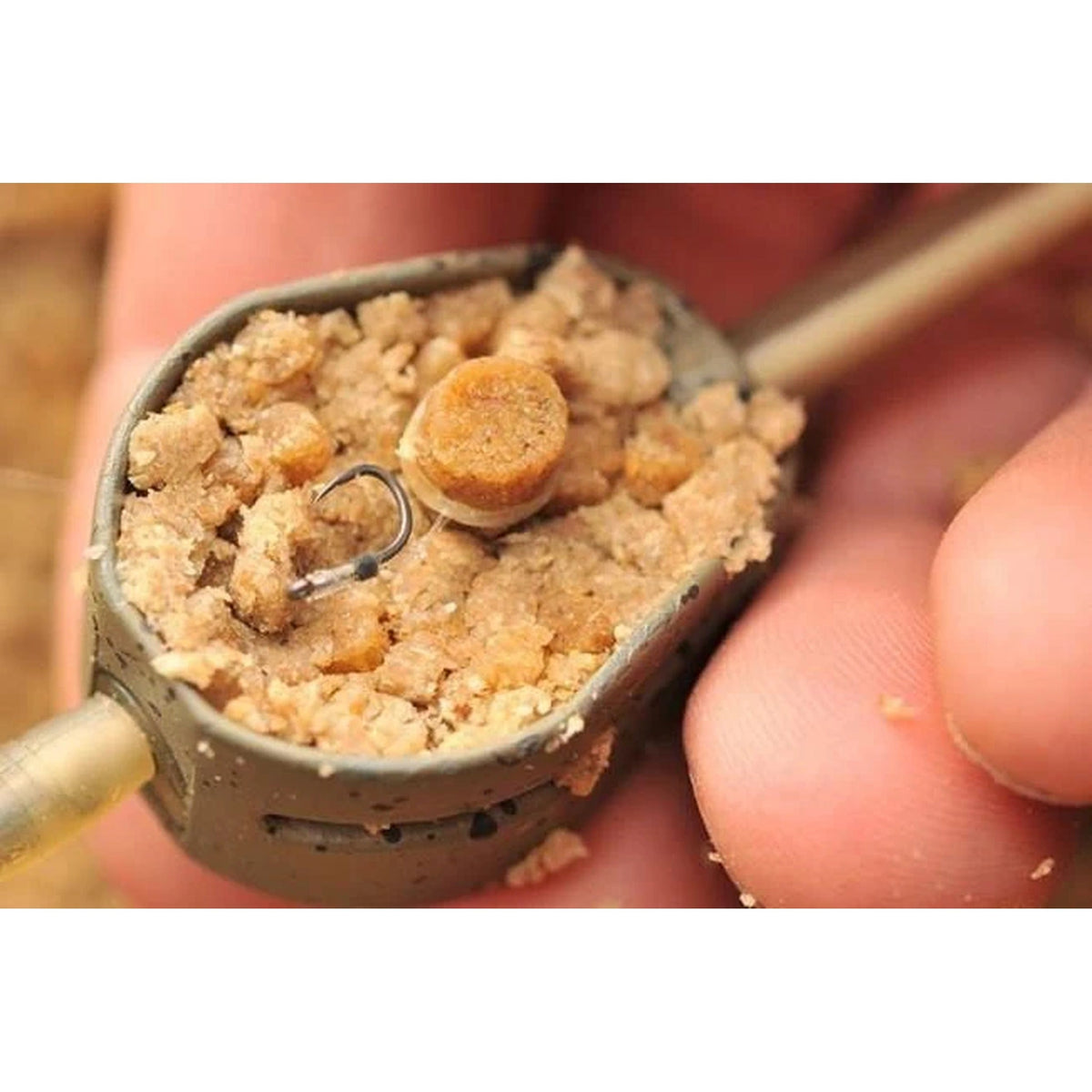
Method fishing is all about a small, concentrated feeding area. A short hooklength suits presenting a pellet or wafter close to the groundbait on the feeder.
A specific example is the short version of the Preston KKM-B Banded Hair Rigs. These hooklengths are available in 10 and 38 cm. The 10 cm version is designed for method and pellet feeder fishing. The rigs feature a barbless hook and a pre-mounted bait band for secure hookbait.
Do not use 10 cm as a universal rule. Check which hooklength suits your feeder system and follow the rules of the fishery. After loading the feeder, also check that the bait and hook can come free and that the hooklength is not wrapped around the feeder.
A longer hooklength with the classic feeder basket
With a standard feeder basket, the hookbait does not need to lie in a compact method groundbait portion in the same way. A longer hooklength is then one option for changing the presentation.
The 38 cm version from the same Preston KKM-B range is intended for, among other methods, the classic feeder basket, bomb and pellet waggler. This makes the range practical when you want to cover different fishing methods with the same type of hair rig.
However, 38 cm is not automatically the best length for every feeder basket. Bait on a hair requires a different consideration than maggots or a piece of worm directly on the hook. First choose a suitable rig and then test the length. Want to learn more about the feeding system itself? Read our guide to method feeders, mesh feeders and open-end feeders.
What about a 15 cm hooklength?
A 15 cm hooklength can be a practical choice at commercial fisheries, provided that length suits the chosen presentation. For example, the 15 cm Preston GPM-B Spade End Hooklengths are ready-made hooklengths with a barbless spade-end hook. They can be used with maggots, small pellets, sweetcorn, meat and worms, among other baits.
The main difference from the KKM-B Banded Hair Rigs is therefore not only the length: the bait attachment also differs. Do not compare hooklengths solely by centimetres. Also consider the hook type, line diameter and how you want to present the bait.
When should you try shorter or longer?
Start with a length that suits your method and observe several casts. Then adjust one factor at a time.
Are you getting taps without a proper positive bite? First check the hook point, bait attachment and any tangles. Then try a different length while keeping the bait, hook and casting distance the same. This allows you to assess more accurately what causes the difference.
Are you getting no bites at all? Then the hooklength may not be the problem. Also check the spot, amount of groundbait and hookbait. A longer hooklength will not solve an incorrectly placed feeding area.
How to test without continuing to guess
- Note what you start with: length, hook size, line diameter and bait.
- Fish several comparable casts in the same spot.
- After every cast, check that the hooklength lies freely and the bait is securely attached.
- Change only the length, as long as you have an otherwise comparable hooklength.
- Assess bites as well as hooked fish; one catch is not yet a reliable comparison.
Store different versions neatly. Ready-made rigs are useful for changing quickly, but always read the label: a different length may also be combined with a different hook size or line diameter.
Frequently asked questions about hooklength length
Is a short hooklength always better for the method feeder?
A short hooklength suits the compact method presentation, but the right version depends on your feeder system, bait and fishery rules. Use the system's recommended rig as a starting point.
Does a longer hooklength produce more bites?
Not automatically. It changes the presentation, but cannot compensate for a poor spot, blunt hook or poorly attached bait. Test purposefully rather than replacing several factors at once.
Can I use the same hooklength for method and feeder basket fishing?
Sometimes, but check whether the length, hook and bait attachment suit both methods. A range with several lengths can be useful; this does not mean every version is equally suitable everywhere.
Choose deliberately and keep your rig simple
Start with the method, then choose a suitable bait attachment and match the hook and line accordingly. Then use hooklength length as a targeted adjustment, not as the first explanation for every missed bite.
With a few well-chosen versions, you can already test many situations. View all hooklengths at Carpshop24 and compare length, hook size and line diameter before choosing your next rig.