A pellet, wafter or mini boilie may perfectly suit your groundbait and fishing approach, but it must also stay securely attached to your rig. You can use different bait attachments for this. Bait bands grip around the hook bait, while a bayonet or bait spike is pushed or twisted into the bait. Both systems keep the hook point free, but they are not equally suitable for every type of hook bait.
The right choice mainly depends on the shape, hardness and diameter of the bait. The way you want to fish also plays a role. Do you want to change pellets quickly, use a ready-made hair, or present a pellet below the hook without tying a hair yourself? In this guide, you can read which system suits each situation.
Would you like to view the available options first? Then compare all bait bands and bayonets.
Why not simply put the hook bait on the hook?
Soft bait such as a maggot or a piece of worm can be placed directly on the hook. With hard pellets, compact wafters and small boilies, this is less straightforward. A hard pellet can crack when you push the hook through it. In addition, hook bait on the bend of the hook takes up space and can affect the hook's free movement.
A bait attachment positions the hook bait beside or below the hook. The hook point remains free and the bait can move more naturally. This makes bait bands, bayonets and bait spikes suitable for method feeder, pellet feeder, bomb and pole fishing. However, the system must suit the bait: a band that is too loose can shift, while a spike has insufficient grip in bait that is too soft or brittle.
What is a bait band?
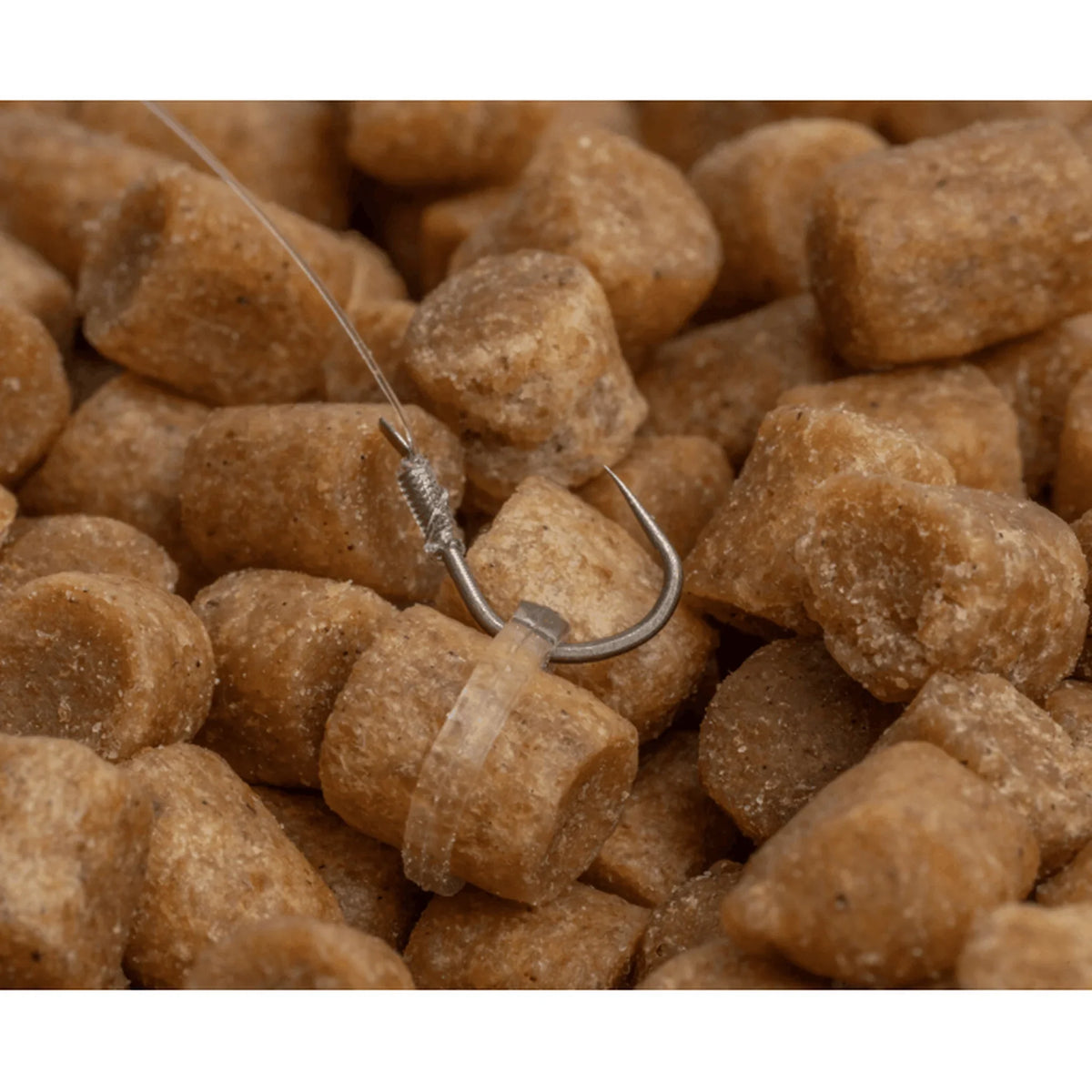
A bait band is a small elastic band that grips around the outside of the hook bait. You therefore do not need to pierce the pellet. This is especially practical for hard, round or cylindrical pellets that are firm enough to be held by the band.
The Captura Baits Bait Bands 3 mm are designed for hard 6 and 8 mm pellets, for example. The pellet remains intact and the hook point stays free. With 120 bands per pack, you also have enough spares for many fishing sessions.
When should you choose a bait band?
A bait band is a logical choice when:
- you are fishing with hard pellets that cannot be easily pierced;
- the pellet is nicely round or regularly shaped;
- you want to change the bait quickly;
- you want to keep the hook point completely clear;
- you fish with a pre-tied hair or ready-made hooklength.
Choose the band size in proportion to the bait. A band that is too small can damage a brittle pellet. A band that is too large will not fit tightly enough and may shift during casting. Therefore, after fitting, check that the elastic is firmly positioned around the centre of the pellet.
What are hookable bait bands?
Not every bait band system requires a tied hair. Preston Hookable Bait Bands have a separate hanging eye. Place the hook bait in the elastic band and then hook the small loop behind the hook bend.
This also allows you to create a free-hanging pellet presentation with a spade end hook without tying a hair yourself first. This is useful when you want to switch quickly between classic hook bait and a pellet while fishing. The band can also be easily removed when you want to fish directly on the hook again.
Make sure the hanging eye is correctly positioned behind the hook bend and cannot slide over the hook point. Before casting, give the bait a quick pull to check that everything is securely attached.
What is a bayonet or bait spike?
In angling, the terms bayonet and bait spike are often used for similar pointed bait attachments. The attachment is tied to the hair. You then press or twist the point directly into the hook bait. This means you do not need a separate band or loose bait stop.
The Preston Bayonets are intended for firm hook bait such as boilies and Band’Ums of approximately 6 to 10 mm. Press or screw the point into the centre of the bait until it fits securely. The pack contains 20 bait bayonets.
The Guru Bait Bayonets are also tied directly to the hair. They are designed for wafters, boilies and pop-ups that are firm enough to hold the point securely. Especially with method, hybrid and bomb rigs, they allow you to change hook bait quickly.
When should you choose a bayonet or bait spike?
A bayonet or spike is suitable when:
- you use a firm wafter, boilie or Band’Um;
- the bait is compact enough to hold the point securely;
- you often want to change hook bait quickly;
- you do not want to use a separate stopper;
- you want to create a compact presentation on a hair.
Always press the point into the centre of the bait. If you start too close to the edge, the bait may split or come loose during the cast. Test the attachment with a gentle pull. If the bait does not stay in place properly, choose a bait band or another type of hookbait.
Bait band or bayonet: the practical difference
A bait band wraps around the outside of the bait. A bayonet or spike, on the other hand, goes into the bait. This simple difference largely determines which system works best.
| Situation | Usually the most logical choice |
|---|---|
| Hard 6 or 8 mm pellet | Bait band |
| Pellet that may crack when pierced | Bait band |
| Firm wafter or mini boilie | Bayonet or bait spike |
| Quick changes without a separate stopper | Bayonet or bait spike |
| Spade end hook without a tied hair | Hookable bait band |
| Ready-made hooklength with band | Pre-rigged bait band rig |
These are starting points, not absolute rules. The composition varies by bait. Two wafters with the same diameter may have different firmness. Therefore, always test whether the bait can withstand a cast and several minutes in the water.
Ready-made hooklength or tie your own?
Those who do not want to tie every hair themselves can choose ready-made hooklengths. The Preston KKM-B Banded Hair Rigs already feature a bait band and a barbless KKM-B hook. The short 10 cm version is designed for method and pellet feeder fishing; the longer 38 cm version can be used with a standard feeder, bomb or pellet waggler, among other methods.
Tying your own gives you more freedom in hook size, line diameter, hair length and attachment. Ready-made rigs save time and make it easy to quickly replace a damaged hooklength. In both cases, check that the length and hook suit your method and the rules of the fishery. For help with this choice, also read our guide on hooklength length for method feeder and feeder fishing.
How to attach a pellet with a bait band
- Choose a band that fits snugly but not excessively tight around the pellet.
- Carefully stretch the band open with your fingers or a suitable tool.
- Place the pellet in the centre of the band.
- Let the elastic close evenly around the pellet.
- Check that the pellet hangs clear of the hook point.
- Gently pull the hair and bait before casting.
Replace a bait band as soon as the elastic is stretched, damaged or torn. A band that still looks usable when dry may have become too loose after several fish or casts.
How to attach a wafter or boilie with a bayonet
- Tie the eye of the bayonet to the end of the hair.
- Hold the hookbait firmly between your thumb and forefinger.
- Place the point in the centre of the bait.
- Gently push or twist the bayonet in.
- Stop once the bait is firmly against the attachment.
- Check with a light pull that the bait does not come loose.
Do not force the point into fragile bait. If the surface tears or the bait crumbles, use a bait band or choose firmer hookbait.
Common mistakes with bait attachments
Using a bait band that is too large
The band will not fit tightly enough around the pellet. The bait can shift or come off during the cast. Match the band size to the pellet diameter.
Pushing a spike into bait that is too soft
Soft or crumbly bait sometimes lacks enough structure to hold a bayonet securely. A bait band, hookable soft bait or hooking the bait directly may then be more reliable.
Only looking at bait size
Diameter is important, but strength is at least as important. Test every new bait type before you start fishing with it.
Blocking the hook point
The benefit of a hair presentation disappears when the bait or a band still sits against the hook point. Check after every bait change that the hook is completely free. If you also want to choose the right hook, read which feeder hook suits your rig.
Which bait attachment should you take with you?
For hard pellets, a well-fitting bait band is usually the easiest starting point. For firm wafters, boilies and Band’Ums, a bayonet or bait spike is often quicker and more compact. If you want to attach a pellet to a spade end hook without tying a hair yourself, hookable bait bands offer a useful intermediate solution.
When in doubt, take two systems with you and test them with the bait you actually use. This will quickly show you which combination stays securely in place and leaves the hook free to work.
View all bait bands and bayonets at Carpshop24 and choose the attachment that suits your pellets, wafters or boilies.