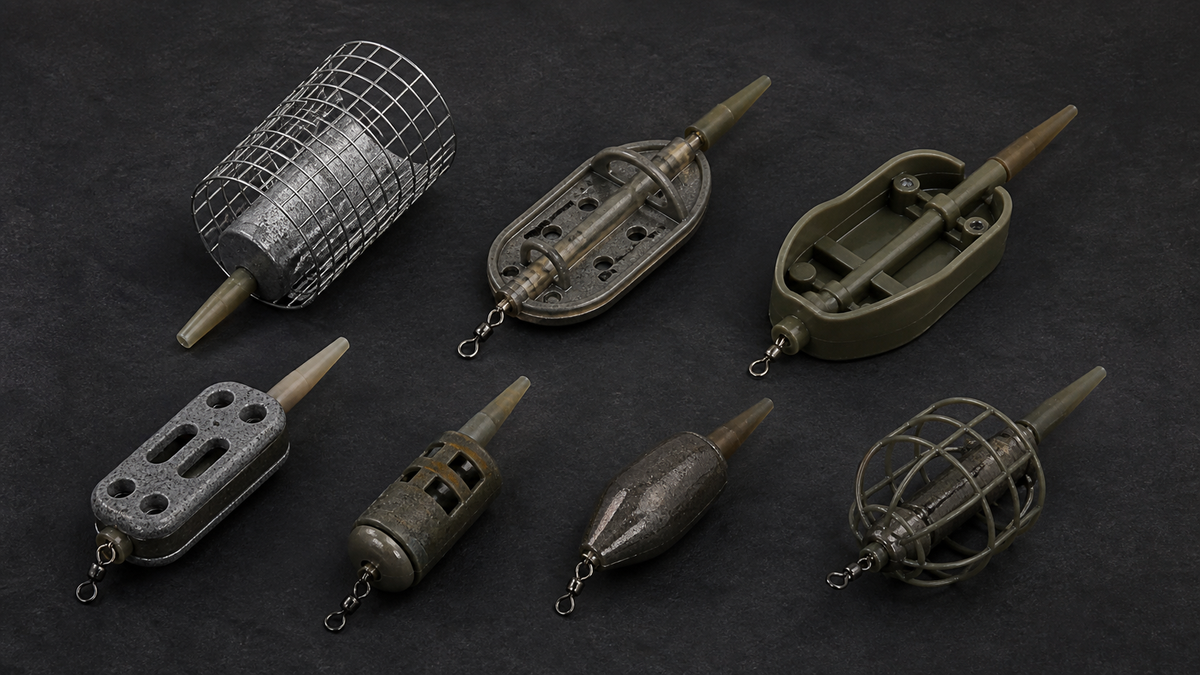
The feeder basket is a small part of your setup, but it largely determines how your groundbait reaches the fishing spot. An open feeder basket releases groundbait quickly, a method feeder presents the hookbait compactly next to the groundbait, and a model with higher sides holds its contents better during a long cast or descent through deep water.
The right choice therefore does not depend solely on the fish species. The venue, current, casting distance, depth and type of groundbait also matter. In this guide, you will find out which type of feeder basket suits each situation, what weight you need and why the lightest basket that stays in place is often the best choice.
Want to compare models and weights straight away? View all feeders, methods, feeder baskets and accessories.
Quick choice: which type suits your situation?
The weights below are practical starting points, not fixed rules. Ultimately, choose the lightest feeder that allows accurate casting and stays in place at your chosen spot.
| Situation | Logical starting type | Indicative starting weight | Why? |
|---|---|---|---|
| Calm commercial fishery, carp or F1 | Flat method, hybrid or banjo | 15–30 g | Compact portion of groundbait with the hookbait close by |
| Canal or still water, roach and bream | Cage feeder | 20–40 g | Fast water entry and active bait release |
| Deeper water or slower bait release | Open-end, hybrid or window feeder | 30–60 g | The contents remain better protected during descent |
| Flowing water or river | Compact, stable river feeder | 50–80 g or heavier if required | Less movement and controlled feeding |
| Maggots or casters at distance | Maggot or window feeder | Match to distance and current | Loose bait reaches the feeding area in a controlled way |
Always include the groundbait in the total casting weight and stay within your rod's maximum casting weight.
Feeder basket and method feeder: what is the difference?
In classic feeder fishing, you usually use a basket that carries groundbait, maggots, casters or other loose feed particles during the cast. Once on the bottom, the groundbait comes out of the basket and creates a feeding area around your hooklength.
When fishing with a method feeder, groundbait or pellets are pressed around or into the feeder. The hookbait lies right next to this compact portion of groundbait. This makes the method particularly suitable for targeted presentation for carp, F1s, bream and other larger coarse fish.
In short:
- choose a classic feeder basket when you want to release the groundbait gradually and recast regularly;
- choose a method feeder when you want to present a compact portion of groundbait with the hookbait right next to it;
- choose a model with higher sides or a more closed design when groundbait and pellets need to remain better protected during the cast or descent.
What types of feeder baskets are there?
Metal cage feeder
A cage feeder is an open mesh feeder. Water reaches the groundbait immediately, allowing it to leave the feeder quickly. This type is a strong all-round choice for groundbait and, if desired, a small amount of live bait.
A cage feeder is well suited to:
- recasting regularly to build up a feeding spot;
- still or lightly flowing water;
- shallow to medium-depth water;
- an active approach for roach, bream and other coarse fish.
The open construction releases groundbait quickly. In deep water or strong flow, this can be a disadvantage when the groundbait washes out of the feeder during the descent. In that case, mix the groundbait a little firmer, use a less open model or choose a feeder that protects the groundbait for longer.
The Preston Wire Cage Feeder is an example of a metal feeder available in various sizes and weights.
Open-end feeder
An open-end feeder has a largely enclosed body with open ends. As a result, water reaches the groundbait less quickly than with a fully open cage feeder. The contents generally stay in place better during the descent and are gradually released on the bottom.
This type is suitable for:
- deeper water;
- light to moderate flow;
- groundbait that must not leave the feeder too quickly;
- longer intervals between casts.
An open-end feeder can also be used to place a core of maggots, casters or pellets between two layers of groundbait. This lets you deliver different bait particles to the bottom in a controlled way.
The Korum Open End Feeder ranges from lighter versions for general use to heavier weights for deeper or flowing water.
Flat Method feeder
A flat Method feeder has a flat, weighted underside. This means it normally lands with the groundbait facing upwards. You fill the feeder with dampened micro pellets or suitable groundbait, often using a mould. The hook bait is presented on top of or right next to the groundbait.
The Method feeder is particularly suitable for:
- commercial fisheries;
- carp, F1s, tench and larger bream;
- short hooklengths and a concentrated presentation;
- accurate fishing in one spot;
- pellets or Method mix pressed around the feeder.
The Matrix Method Feeders are available in several sizes and weights. This allows you to adapt the same presentation to the distance, depth and amount of groundbait you want to introduce.
Hybrid or banjo feeder
A hybrid or banjo model combines the characteristics of a Method feeder with higher side walls. These walls keep groundbait or pellets in place better without fully enclosing the presentation.
This is especially useful when:
- you need to cast further;
- the water is deeper;
- your groundbait needs to stay better protected on impact;
- a classic open method loses groundbait too quickly.
The Guru Hybrid Feeder In-Line System can be filled without a traditional method mould and, thanks to its raised edge, can be used at a range of distances. Another popular shape is the Preston In-Line Banjo XR Feeder, whose raised shape provides extra protection for the contents.
Pellet feeder
A pellet feeder is designed to deliver moistened pellets to the spot in a controlled way. Its more closed shape helps prevent the pellets from coming loose during casting or sinking. This type works well when pellets form the basis of your approach and you want to keep the feed portion compact around the hook bait.
Always check how much moisture the pellets need. Pellets that are too dry will not stay in the feeder properly, while pellets that are too wet can stick together and release far too slowly. Want to know which pellets suit this type of fishing and how to prepare them? Also read the guide Which Coppens pellets should you choose?.
Window or maggot feeder
A window feeder has an opening that allows you to place maggots, casters, pellets or a combination of bait and groundbait in the feeder. The closed section protects the contents during the cast and descent. A maggot feeder uses the same basic principle, but is specifically designed to allow live bait to escape gradually.
These feeders are useful when you want to present loose bait in a controlled way at depth or distance.
What feeder weight do you need?
As a basic rule, use the lightest feeder you can cast accurately and that remains stable after landing. A heavier feeder is not automatically better. Too much weight puts strain on the rod and makes the rig less subtle, while a feeder that is too light can shift due to current, wind or a tight line.
As a practical starting point, you can consider:
- 15 to 30 grams: short to medium distance on calm, still water;
- 30 to 45 grams: medium distance, greater depth, a light crosswind or weak current;
- 45 to 60 grams: longer casts, noticeable wind or moderate current;
- more than 60 grams: stronger current or targeted long-range fishing, provided your rod and line are suitable.
These are not fixed rules. The shape of the feeder, amount of groundbait, line diameter, wind direction and bottom conditions all have an impact. For example, a compact, aerodynamic 45-gram feeder can cast farther and more accurately than a large open feeder of the same weight.
Also consider the total casting weight. The weight shown on the feeder is usually the weight of the empty feeder. Once filled, the groundbait and hook bait are added to this. Therefore, always check the maximum casting weight of your feeder rod.
Which feeder size should you choose?
The size determines how much groundbait you deliver to the spot per cast.
Choose a small size when:
- the water is cold;
- the fish are feeding cautiously;
- you want to feed little but very accurately;
- you recast regularly and want to avoid overfeeding.
Choose a larger size when:
- the fish are actively feeding;
- you want to build up a feeding spot quickly;
- there are many fish on the spot;
- you want to use larger groundbait particles.
When in doubt, start small. You can always cast more often or switch to a larger feeder later. You cannot take an oversized groundbait portion back out of the water.
Which feeder for still water?
On a pond, canal without noticeable current or commercial fishery, you can usually fish relatively light. For a classic approach, a small or medium cage feeder is often sufficient. If you want to target carp, F1 or larger bream, a flat method, hybrid or banjo is a logical choice.
Pay particular attention to distance and the bottom. On a soft bottom, a wide, flat feeder may sink in less deeply than a compact weight. Do not use more weight than necessary, and position the rod tip so that wind or a tight line does not pull the feeder across the bottom.
Which feeder basket for flowing water?
In flowing water, the feeder must remain stable on the bottom. Therefore, choose sufficient weight and pay attention to the shape. A feeder with a flat profile or extra grip generally holds better than a round, light feeder.
In current, these points are important:
- increase the weight gradually until the feeder remains stable;
- use a size that does not catch unnecessary water pressure;
- choose groundbait that only releases from the feeder near the bottom;
- cast to the same spot every time to create a clear feeding area;
- check that the total casting weight remains within your rod's limit.
Sometimes a small, heavier feeder is better than a large model with the same lead weight. The smaller feeder catches less current and still delivers enough groundbait when you recast regularly.
Which feeder should you use at long range?
For long casts, an aerodynamic shape, stable flight and well-positioned weight are important. A compact distance, bullet, hybrid or banjo model generally casts more easily than a wide open feeder.
Accuracy remains more important than distance alone. Choose a fixed reference point on the opposite bank, use the line clip when conditions allow it safely, and practise with the same amount of groundbait on every cast. This keeps not only the feeder, but also the groundbait portion, roughly the same each time.
Match the groundbait and feeder
Even the right feeder works less well when the groundbait is prepared incorrectly.
For a cage or open-end feeder, the groundbait needs to be firm enough to withstand the cast and descent, yet release quickly from the feeder on the spot. Compress the groundbait more firmly for greater depth or current, and more loosely for shallow, still water.
For a method feeder, micro pellets or method mix must bind sufficiently to withstand the cast. However, after landing, they should not remain as one hard lump around the feeder. Therefore, moisten groundbait or pellets in small stages and test at the bank how quickly the contents are released.
If you use a method mould, check that the brand, range and size match the feeder. A mould that does not fit properly fills unevenly or makes the feeder difficult to release.
Inline, elastic or free-running?
The rig must suit the chosen system and the water you are fishing. Many method feeders are used inline. Other models work with an interchangeable stem, elastic system or swivel connection.
Do not simply combine components because they look alike. Beads, stems, elastics and feeders are often designed as one system. Use compatible components and follow the manufacturer's instructions so that the rig functions properly and remains as safe as possible for the fish in the event of a line break.
On waters with specific competition or fishing regulations, certain elastic or fixed systems may be prohibited. Therefore, check the local rules beforehand.
A quick guide
In these situations, usually choose:
- actively feeding for roach and bream: cage feeder;
- deep water or slower groundbait release: open-end feeder;
- carp, F1 and larger bream on a compact feeding spot: flat method feeder;
- deep water or casting further with method groundbait: hybrid or banjo feeder;
- targeted feeding with moistened pellets: pellet feeder;
- presenting maggots or casters in a controlled way: maggot or window feeder;
- strong current: compact, stable model with sufficient weight;
- long distance: aerodynamic distance or bullet model.
Ideally, take several weights with you. The right choice can change during the same fishing day when the wind picks up, the current changes or you need to fish further out to get bites.
Common mistakes when choosing a feeder
Starting too heavy straight away
A heavy feeder does not cast more accurately in every situation. Start as light as possible and only go heavier when distance, wind or current requires it.
Only looking at the lead weight
The shape and size also determine how a feeder flies and how much water pressure it encounters. Two 40-gram feeders can therefore behave very differently.
Making the groundbait too wet or too dry
Groundbait that is too dry falls out of the feeder during the cast. Groundbait that is too wet remains on the bottom as a hard mass. Add water gradually and test the release close to the bank.
Putting in too much groundbait
A large feeder is not always the quickest route to more fish. Especially in cold water or on difficult days, a small, accurate portion of groundbait can work much better.
Using the wrong mould
Method moulds are often size- and series-specific. Before buying, check whether the mould actually fits your feeder.
Frequently asked questions about feeders and method feeders
Is a method feeder the same as a feeder?
A method feeder is a type of feeder, but the presentation differs from a classic feeder. With a method, a compact amount of groundbait sits around the feeder and the hookbait is positioned very close to it. A classic feeder builds a looser groundbait area around the rig.
What weight method feeder should I choose?
Choose the lightest method feeder that reaches the desired distance and remains stable. On calm water and at short range, 15 to 30 grams is often sufficient. For more distance, depth, wind or current, 30 to 60 grams or more may be needed. Include the weight of the groundbait in the total casting weight.
Which feeder is best for bream?
That depends on your approach. A cage or open-end feeder is ideal for building a classic groundbait spot. On commercial fisheries or when you want to fish for larger bream in a compact area, a method feeder can be very effective.
Do I need a mould for every method feeder?
No. Some flat methods are easiest to fill with a suitable mould, while hybrid and certain pellet feeders can also be loaded by hand. Check the product information and only combine compatible sizes and systems.
How do I know whether my feeder is heavy enough for the current?
After landing, the feeder should stay in the same spot. If you repeatedly see the rod tip relax and bend again, or the line moves downstream, the feeder may be rolling or sliding. Gradually choose more weight or a more stable model.
How many different feeders do I need?
With one type in a few weights, you can already cover many situations. For a versatile basic setup, a light and heavier cage feeder, plus a small and medium method or hybrid, are a practical starting point. Only expand based on the waters you actually fish.
Conclusion: choose according to water, groundbait and distance
There is no single best feeder for every situation. A cage feeder releases groundbait quickly, an open-end feeder protects the contents for longer, and a method, hybrid or banjo keeps the hookbait close to a compact portion of groundbait. Then choose the lightest weight that allows you to cast accurately and fish steadily.
By matching the type, size and weight to the venue, you not only fish more accurately but also use exactly enough groundbait. View the current range of feeders, methods, feeders and matching accessories and compare the available shapes and weights for your next session.